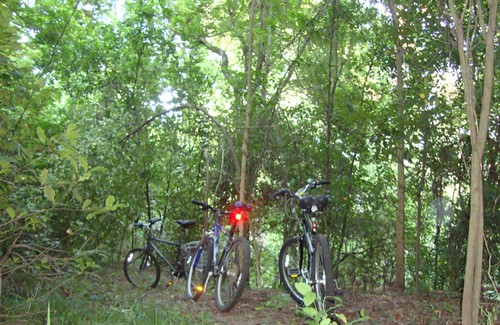
"The Bike trail is now connected from River Oaks Meadow to the Red River Link. Loren, Feico and I," says Maurice Loridans, "recently worked to finish the connection with the work done by Centenary Volunteers led by Katherine Brandl and Robert Trudeau."
Having traversed the new East Side Coates Bluff Trail by bicycle, a slow and chunky experience, I can testify that it is appropriate for advanced riders.
While the new trail is intended to give bikers their own territory, I highly recommend it to hikers.
Loridans also reported, "Feico and I walked and groomed the East-West part and swing bladed the knee-waist high growth that was already clogging the Link from the wide gate at Valencia's Urban Farm. Heading East from there, the trail is clear to a point on the North side of a very high steep bank of the old river bed. Beyond that point are many deadfall trees and more work."
"To hold what we have done," warns Loridans, "it is imperative that this trail gets traffic by walking or bikes."
The entrance to the new trail is somewhat hidden. It begins at the place where the walking trail opens up in the direction of the neighborhood housing area called River Oaks.
Once found, this trail takes you much deeper into the riverine woods.
Poison ivy is sprouting vigorously this time of year. But on last week's sortie I wore long sleeves and long pants and have yet to feel any itching or rash.
If you walk it this weekend, please send me a brief report and photo: trudeau11@gmail.com.

Friday, May 11, 2012
Coates Bluff Trail now has a parallel path for hiking and biking on the East side of the old Bayou Pierre slough


Monday, May 7, 2012
Regular Meetings on Summer Hiatus; Radio Show Will Continue
 Due to the fact many of us will be out of town here and there through out the summer, we've agreed to take a break from our regular weekly meetings until August 27th. In the meantime, we'll be pushing forward on our various projects throughout the summer, using this blog and facebook to announce events, work sessions, social bike rides, etc., or just to post thoughts on quality of life improvements for the city.
 In the immediate future, Loren Demerath, Maurice Loridans, Feico Kempff, and Kevin Kennedy recently completed clearing a way for the new mountain bike to parallel the nature trail on the Bossier Parish side. Plans are to meet Monday at 6:15 to ride back and forth into shape. All are welcome. We'll be meet at the Montessori parking lot on Valencia with our mountain bikes, then plunge into the woods.
Loren will also be reporting on his six day paddle trip down Bayou Teche, from upwards of Lafayette down to Morgan City. It's the site of a relatively new but now nationally known race for flat water paddling. Could there be a complementary race organized upstate to take advantage of the paddlers who'll be in our state? The Tour du Teche takes place in October, by the way.
Friday, May 4, 2012
New Bike Paths in South Louisiana Funded by Federal Highway Administration
I just ran across this article while planning a canoe trip down Bayou Teche from Lafayette to Morgan City. It's about a new set of bike paths linking paddling trails funded mostly by Federal Highway Administration dollars. That's our money too, y'all! We might as well ask for some up here!
Sunday, April 29, 2012
Group discusses trail improvements, bike-ped concerns, and more at last meeting
In attendance: Susan Keith, Katherine Brandl, Loren Demerath, Maurice Loridans, Feico Kempff, Elizabeth Rosselli, Cynthia Keith, John Settle.
Coates Bluff
The meeting began with discussion of the Coates Bluff trail system. Last Saturday, several members, with the assistance of LA Tech Art Department faculty member Kevin Kennedy , cut the 200 yards of trail on the south Bossier end of the system. The group cleared the trails without the use of fossil fuels, but the last 100 yards might necessitate the use of chainsaws to cut through fallen trees. The passages should be wide enough for the passage of bikes, but not 4-wheelers. Loren wants to finish this project before he leaves for Ecuador. The group believes the project would only take a day with a two-man cross saw. This fall a large group could cut a parallel trail on the northside clearing.
The group mentioned the need for signage. Maurice made a sign labeling the path to Stoner Hill Elementary with a magic marker, a plank of wood (approximately 1x6feet), and a spare inter-tube tire. Users might find navigating the trail system difficult, so the trail might need maps or signs. Loren mentioned that groups put little signs to show that they care, such as the Apple Tree Hole on a golf course. The group might think about posting fun signs. A car hood has also been recycled as a bridge over the culvert's earth dam. The trash dumped in Greenwood Cemetery presents an additional challenge. Jon complained in the past about citizens dumping trash in the cemetery. Because of the high fine charged, threatening to report the city unless the trash is cleaned up might solve the problem.
Bike-ped concerns
The rejection of a school zone for the local Montessori School was also discussed. Jon and some school administrators want to create a school zone at East Washington. A letter was sent to the city, but the city rejected the request. The city conducted its traffic study during the wettest and coldest weeks of the year, so few were cycling or walking. The city traffic engineer said the area has a low accident percentage and pointed out negative side effects of school zones. School zones makes turning motions difficult and increases traffic congestion, especially at schools where large numbers of students are driven by their parents. Loren mentioned this event to a friend working in transportation issues at the national level. The friend offered to speak with Shreveport's traffic engineer once a proposal for the school zone is drafted. Safe Routes to Schools could fund the construction of a school zone because the city enjoys receiving funds and looking good.
Pedestrian concerns downtown were also mentioned. The downtown pedestrian crosswalks have buttons that allow persons to cross on-demand. This is what Montessori wants because it would only slow/stop drivers if there were pedestrians. The technology has never been activated, so persons just push in vein. The placement of crosswalks is another challenge. Persons wanting to cross from Lee Dry Goods Apartments to Festival Plaza are supposed to walk to Crockett and Market to legally cross.
The crosswalks represent an important concern with urban planning decisions. From the city's point of view, people should not cross at certain points because they are dangerous. The group believes people are crossing at these points, so the city planners should do something to improve crossing conditions. The city only takes action to improve crossing safety after deadly accidents. Shreveport's civil engineers were educated to expedite the flow of automobile traffic, including interstates. Today's students learn the best practices for bike-pedestrians. The city needs improved civil engineering, but improvements are unlikely.
Why so little progress?
As such, the group discussed reasons why traffic concerns remain. Some suggested Shreveport operates as a fiefdom rather than in a managerial fashion. In the current structure, cities rely upon a few key officials, and these officials make decisions based upon the size of their workloads. The group thus mentioned how to fix these policy issues. Citizens must advocate rather than use lawsuits to affect change because the city has a legal department precisely to mitigate the necessity to change its policies.
Officials from the city and Montessori reduce their liabilities by advocating against usage. The school director suggested Loren and his children wear high visibility vests when walking, but should pedestrians need special clothing to walk around. The school director warned about the risks and thus cannot be sued if anyone is injured. The public beach at Jimmy Davis is another example. Individuals who cannot swim and boaters have both drowned. ABS and the city cannot advocate usage because of liability concerns. Mayor Glover did not even want to put warning signs because it could open the door for later liability lawsuits. The city of Shreveport will not advocate the use of trails on the other side of Clyde Fant because doing so would allow potential liability.
Coates Bluff
The meeting began with discussion of the Coates Bluff trail system. Last Saturday, several members, with the assistance of LA Tech Art Department faculty member Kevin Kennedy , cut the 200 yards of trail on the south Bossier end of the system. The group cleared the trails without the use of fossil fuels, but the last 100 yards might necessitate the use of chainsaws to cut through fallen trees. The passages should be wide enough for the passage of bikes, but not 4-wheelers. Loren wants to finish this project before he leaves for Ecuador. The group believes the project would only take a day with a two-man cross saw. This fall a large group could cut a parallel trail on the northside clearing.
The group mentioned the need for signage. Maurice made a sign labeling the path to Stoner Hill Elementary with a magic marker, a plank of wood (approximately 1x6feet), and a spare inter-tube tire. Users might find navigating the trail system difficult, so the trail might need maps or signs. Loren mentioned that groups put little signs to show that they care, such as the Apple Tree Hole on a golf course. The group might think about posting fun signs. A car hood has also been recycled as a bridge over the culvert's earth dam. The trash dumped in Greenwood Cemetery presents an additional challenge. Jon complained in the past about citizens dumping trash in the cemetery. Because of the high fine charged, threatening to report the city unless the trash is cleaned up might solve the problem.
| Maurice's new sign for Stoner Hill Elementary |
The rejection of a school zone for the local Montessori School was also discussed. Jon and some school administrators want to create a school zone at East Washington. A letter was sent to the city, but the city rejected the request. The city conducted its traffic study during the wettest and coldest weeks of the year, so few were cycling or walking. The city traffic engineer said the area has a low accident percentage and pointed out negative side effects of school zones. School zones makes turning motions difficult and increases traffic congestion, especially at schools where large numbers of students are driven by their parents. Loren mentioned this event to a friend working in transportation issues at the national level. The friend offered to speak with Shreveport's traffic engineer once a proposal for the school zone is drafted. Safe Routes to Schools could fund the construction of a school zone because the city enjoys receiving funds and looking good.
Pedestrian concerns downtown were also mentioned. The downtown pedestrian crosswalks have buttons that allow persons to cross on-demand. This is what Montessori wants because it would only slow/stop drivers if there were pedestrians. The technology has never been activated, so persons just push in vein. The placement of crosswalks is another challenge. Persons wanting to cross from Lee Dry Goods Apartments to Festival Plaza are supposed to walk to Crockett and Market to legally cross.
The crosswalks represent an important concern with urban planning decisions. From the city's point of view, people should not cross at certain points because they are dangerous. The group believes people are crossing at these points, so the city planners should do something to improve crossing conditions. The city only takes action to improve crossing safety after deadly accidents. Shreveport's civil engineers were educated to expedite the flow of automobile traffic, including interstates. Today's students learn the best practices for bike-pedestrians. The city needs improved civil engineering, but improvements are unlikely.
Why so little progress?
As such, the group discussed reasons why traffic concerns remain. Some suggested Shreveport operates as a fiefdom rather than in a managerial fashion. In the current structure, cities rely upon a few key officials, and these officials make decisions based upon the size of their workloads. The group thus mentioned how to fix these policy issues. Citizens must advocate rather than use lawsuits to affect change because the city has a legal department precisely to mitigate the necessity to change its policies.
Officials from the city and Montessori reduce their liabilities by advocating against usage. The school director suggested Loren and his children wear high visibility vests when walking, but should pedestrians need special clothing to walk around. The school director warned about the risks and thus cannot be sued if anyone is injured. The public beach at Jimmy Davis is another example. Individuals who cannot swim and boaters have both drowned. ABS and the city cannot advocate usage because of liability concerns. Mayor Glover did not even want to put warning signs because it could open the door for later liability lawsuits. The city of Shreveport will not advocate the use of trails on the other side of Clyde Fant because doing so would allow potential liability.
Thursday, April 26, 2012
Wednesday, April 25, 2012
The Distinctive City
The Distinctive City: Cities are seeking the recipe for economic success in a rapidly changing global marketplace and, in the process, often overlook a critical asset: community distinctiveness. Special places, characteristics and customs have value, and they can increase a city’s competitive edge.
Monday, April 23, 2012
Group discusses local events, future Coates Bluff planning and funding, local advocacy, and more at 4/16 meeting
In attendance: Susan Keith, Cynthia Keith, Maurice Loridans,
Katherine Brandl, Loren Demerath, Elizabeth Rosselli, John
Weekend Events
The group began by discussing local events happening next
weekend. Chimp Haven is having an event Saturday, April 21 where the Dog Park
Alliance will be represented. There will be two workdays on the Coates Bluff
trail system this weekend. The group expressed concerns that Jon’s Saturday
cleanup would tax the potential volunteers for Sunday’s trail clearing, but
some thought Jon would draw his volunteers from elsewhere. The group will ask
Jon if he needs additional help, but the Sunday afternoon work session stays at
its scheduled time for now. In addition to these activities, there will be an
Afro-centric childcare program on Sunday.
The group talked about the goals for Sunday. The parallel
bike trail portion must be cleared while the weather cooperates. Centenary’s
Math Department cut the trail from Valencia Park to the clearing several weeks
ago, but this week the volunteers will clear the Clyde Fant portion of the
trail. Some expressed concerns about the ability to find the clearing portion
of the trail after a few months, but Katherine believes users will easily find
the trail because much of it runs along an old road. The group hopes that the
trail will connect to the tunnel under Clyde Fant after. The group estimates that
this trail will be 1 ½ mile long when finished.
Future Coates Bluff goals
The group planned for the completion of the mountain biking
trail. Maurice explained the layout of this new trail would begin at the culver
at the top of the loop, from which one can see the River Oaks neighborhood. The
group mentioned the possibility of handing over the trail to the local mountain
bike riders, so riders obtain the desired narrow single track trail. John
explained the 100 Miles to Nowhere event as an option to finish the mountain
biking trail. These Livestrong-sponsored charity events have participants ride
a small course for 100 miles; such an event could be used by bikers to set the
course of the new trail. John said he
would discuss this idea with Ian.
 |
| Example of a 100 Miles to Nowhere course in Manasses, VA |
The group wants to requisition the surrounding terrain to
enhance users’ trail experience. The group also talked about requisitioning an
old car sitting along the trail; the possibility of building a bridge over the
car rather than removing it was mentioned. Concerns about the challenges logs
in the nature trail’s path were presented, but Maurice stated that a couple
logs, especially near the beginning and end of the trail, prevent 4-wheelers
from requisitioning the trail. On the bike path, Maurice suggested that
planning a few narrow passes between trees would discourage 4-wheeler usage.
Funding
Because of upcoming deadlines for the group’s grants,
funding matters were discussed. Loren spoke with a representative from Senator
Landrieu’s Washington, D.C. office about local trail possibilities. Landrieu is
interested in funding for Louisiana waterways, but budget cuts made the office
suggest agencies and grants for funding. The Landrieu office suggested private
funding options.
The group debated a potential marketing pitch Loren created
to entice Wal-mart’s corporate sponsorship of trails. The company could give
private funds to match public, government funding. Wal-mart is close to the
trails, and many shoppers do not have cars. Though Wal-mart is promoting a
greener image, the company will likely turn the proposal down, but pitching the
idea cannot hurt. Others suggested that Wal-mart place bike racks at their
stores, while others preferred using the Garden Center’s railing.
Advocacy
Events from last week brought discussion of the group’s advocacy
goals and objectives. Maurice left the Makers Fair last weekend to attend Frances
Kelly’s spring training event for the Occupy movement at the Highland Community
Center. Unions and teachers were the most widely represented groups at the
meeting. The attendees have picked an issue to protest at one local politician’s
office. Interested individuals can contact Valerie Loridans for further
details.
One strength of local organizing is that individuals have
common goals but want to accomplish them in different ways. One such issue, the
closure of public libraries, is becoming a national trend. The group is proud
that ABS does things positively and does not go negative in their tactics. If
the group needs volunteers, it can network and build loose alliances when it
needs to. Loren suggested encouraged citizen-activists, and several members reiterated
that just being around often helps get things done. Finally, the group wishes
to remind citizens that the vote for the new member of the Metropolitan
Planning Commission is May 3. One of the group’s own is running and would like
our support in his quest to implement the Master Plan.
ABS discusses Earth
Day Clean-up, Bike Routes, Waterways, and future Dog Park Alliance events
In attendance:
Katherine Brandl, Carolyn Manning, Susan Keith, Maurice Loridans, Loren
Demerath, Elizabeth Rosselli, Cynthia Keith, Feico Kempff.
TRAIL-CUTTING ON 4/22
AT 2:00
The group talked
about the need for a workday in the coming weeks, while the weather remains
cool. Other upcoming events: Makers Fair (April 14), Chimp Haven (April 21),
and Downtown Clean-up Day (April 28) were discussed to best schedule the
workday. The Clean-up Day is necessary to clean the vicinity after the Makers
Fair because people leave trash as they walk to their cars. Because numerous
members plan to attend the event at Chimp Haven, the group decided to meet
Sunday, April 22 in the afternoon.
The April 22 workday
will clean the portion of the trail left unfinished from Centenary’s Big Event.
The volunteers will meet at the Montessori parking lot at 2:00 and cut through
the woods on the northern side of the right-of-way with loppers. This
represents the Bossier Parish bike route of the Coates Bluff trail system. The
Earth Day event will focus on the trail. In addition, Maurice suggested that
the group GPS the trail, and put the route online for
individual download. The results would allow the group to show landowners our
efforts. The group would need to find the appropriate “app” to use because
under tree canopy satellites can only guess where the user is.
 BIKE ROUTES TO MAKERS
FAIR
BIKE ROUTES TO MAKERS
FAIR
Maurice offered
suggestions for potential bike routes to the Makers Fair, but the route depends
upon one’s starting point. Texas Avenue is a good bike route because it was
built before cars, and road conditions favor mules. If coming from the east
side of town, one rides along Marshall, and the north side has Hawn Avenue and
Grimmett Drive. The west end of town has Lakeshore Drive and Ford Street. While
Milam Street is hilly, it is a good route. For those arriving from outside of
Shreveport, Highway 80 remains a good path. Lastly, bike users near the lake
can take the trails.
The group delayed
discussing the fall tree tour because John Robert and Garrett were not present
and the local bayous until Jon visits.
BIKE-BOATS??
Loren told the group
about a bicycle Ian Webb told him about, the Wave Bike. The bicycle is meant to
propel a boat. Ian knew the designer, a man who wanted to build a bike-boat.
The device is the length of a canoe but looks like a kayak. The device utilizes
a propeller for mobility and a keel to maintain balance on the water. The
device uses the racing position on a bike because it’s believed to be the most
efficient. A Louisiana Tech art professor explained how such a bike could be
built. The device beat the eight-men rowing crews, some of the fastest man-made
devices on the water, when tested at a regatta.
Some suggested these
bike-boats as options for local water tourism. Wave bikes would be manufactured
and available for rent. The practicality of the device for local use was
debated. Underwater topography makes paddlewheels rather than propeller a
better option. The inventor has stopped manufacturing Wave Bikes, so the
potential for these bikes is limited.
WATERWAYS
APPRECIATION
Members described
their recent experiences on the local waterways. Maurice and Jon recently saw a
bald eagle near the Isle of Capri, and there has been a mating pair on Cross
Lake for decades. Jon debriefed Maurice on his recent trip down Bayou Pierre.
The salvenium blooms on Bayou Pierre cannot be completely eradicated, and the
phenomenon began as a single strand on someone’s equipment. The group discussed
possible solutions for these problems. The group wants the waterways to remain
boat-able.
VALENCIA PARK FUTURE?
The group talked
about future plans for Valencia Park. Feico attended the Valencia meeting where
the city’s bond money was discussed. The maintenance and liability coverage on
the pool at Valencia Park uses half of the budget, so the pool is permanently closing.
The pool could become a water feature or be torn down and the pool house used
for storage. The closure of the pool saddens some members concerned about
children’s access to swimming pools, especially during summer. The group thinks
tearing down the building would be a waste and several alternative solutions
were suggested. Feico suggested the building be used as a senior center. As
Valencia Park has the largest community garden in the area, the pool house
could be used to sell the garden’s products. The thick walls would be good for
a cheese cave. The building could also be used as an interpretative center for
Coates Bluff usage.

MORE DOG PARK
FUNDRAISERS!
The group concluded
by updating on the Dog Park Alliance. The Dog Wash at Marilynn’s was a success.
The Dog Park Alliance will host a 5K-Dog Jog on May 26 at 8am. The two runs
will start at the dog park. The 5K starts at Hamil Memorial Park along the
river, and the event is looking for a sponsor. After the runs, there will be a
Sniff out the Dog Park party after with vodka-freeze machines and live music.
Cynthia expressed the need for volunteers to hand out water along the course
and assist the event. Cynthia explained the changed address for the
organization, one donated by the Shreve-city UPS store. Future correspondence
can be sent to:
Box #151
1214 Shreveport-Barksdale Highway
Shreveport, LA 71105
Several miscellaneous
items were lastly discussed. Several issues concerning Centenary led to
discussion. The group discussed upcoming changes to Centenary’s residency
policy that will require undergraduates to live on-campus. These changes will
need discussion moving forward. One member recounted her recent experience
helping a female student access her dormitory; the school has some A.D.A. problems.
Cynthia reminded the group of the Cross Lake Flotilla on June 2 at the American
Legion on South Lakeshore Drive. Some suggested a similar event on the Red
River, but this move would be time-taxing for Cynthia. Because fewer people
live along the river, attendance and planning would be harder.
(notes compiled by
ABS intern, Elizabeth Rosselli)
ABS discussed plans
for the future of the Coates Bluff trail system at the last meeting (April 2).
In attendance: Ken
Hawkins, Loren Demerath, Caroline Major, Susan Keith, Cynthia Keith, Elizabeth
Rosselli, Garrett Johnson, and Susan Fontaine.
The group began by
handling past business and discussing last week's events. As part of the
group's continuing fundraising efforts, Loren promised to scan the IRS
nonprofit letter for PayPal. This should enable PayPal fundraising soon. The
group also discussed last Monday's TEDx talk at BPCC, which took the place of
the regular meeting. The event showed the best of the past year's events, as
well as some local speakers. Many did not attend, stating they were unaware of
the event until afterwards. The group might need better communication with
organizers.
Loren told the group
about last activity on the Coates Bluff Trail last Saturday. As part of
Centenary's Big Event, twenty-four students and faculty helped clear the trail.
One team of five students went from Valencia along a grassy patch of the
pipeline right-of-way. This patch consists of a 100-300 foot stretch north of
Montessori, but concerns about its maintenance were raised. The possibility of
Centenary consistently mowing was raised, but Maurice believes an open-air
trail will require frequent maintenance. Caroline said regular heavy usage
should keep inhibit excessive grass heights. These trail maintenance issues
could be minimized by altering the trail to pass through the woods instead, and
the wooded design would protect against extreme summer heat.
Some raised concerns
about the legality of the alteration because the wooded areas are privately
owned. The group's legal minds explained how issues of trespassing could be
circumvented by of the rights of passage and servitude. Louisiana legal code
encourages the usage of private, not government, lands that lack posted
signage. The group could establish a trail with well-documented public usage,
i.e. access to Veterans' Hospital. After ten years the property owners cannot
stop public usage anymore. In the event Riverscape is developed, the trail may
be rerouted, but the trails would still be provided. This issue should be
explored further in future meetings.
In addition to the
above mentioned segment of trail, the group discussed an additional trail
parallel to the current Nature Trail. As part of Centenary's Big Event, various
crews began clearing a parallel trail for mountain bikers. The idea of a rake
& ride solution for trail layout would enable the riders to obtain a
desirable system. Maurice pointed out that BMX riders would create unnecessary
turns to build challenges, so rack and ride might present future problems.

As part of continuing
discussions of the trails system, conversations shifted to the grants. The lack
of progress with the grant money from the parish and Wildlife is seen because
of the term "conservation easement" in the grants' language. The
group is awaiting the parish's call about the grant money, so we will know how
to proceed. The group also looked beyond local governmental organizations for
support, and several organizations were pitched as possible partners for the
maintenance and expansion of the trails. The group never received definitive
rejection from the national offices of the Nature Conservancy, so the Louisiana
chapter of the Nature Conservancy should be spoken to.
Ducks Unlimited seems
a good potential partner for the group's projects. Ducks Unlimited is probably
the largest conservancy in the country, working on wetlands. The placement of
wooden ducks and sorghum would prevent duck hunting on the group's trails. Ken
showed a map of all Ducks Unlimited projects in Louisiana. Ducks Unlimited
already has one 900-acre project restoring Bayou Pierre in Red River Parish. Ducks
Unlimited has spent on average $5 million per year on Louisiana projects over
the last five years.
Jon's ideas for the
local waterways were transmitted to the group. These canals run throughout the
state, and the availability of canoe rentals could encourage tourism. The new
route for 3132 presents a problem for Bayou Pierre's future. The proposed new
route would wreck Bayou Pierre but will never get done because of the
property's value. The push for the 3132 completion arises out of the inability
to access businesses along the Port. Caroline believes the Port is a valuable
asset for Shreveport, but businesses do not locate in Shreveport because
semi-trucks and roads infrastructure.
The meeting concluded
with the group talking about outreaching to surrounding communities and
organizations that want to create trails. The progress on Coates Bluff stands a
potential model for other interested parties to begin trails projects. The
group could help these parties establish trails if they were open to the public
and the system of interconnected trails throughout the region would be closer
to fruition. The group expressed the possibility of scheduling a work day
before spring is over.
Lead UL Coleman
Developer Cole Guthrie Describes Plans for New Coates Bluff Development at ABS
Meeting
In attendance: Loren
Demerath, Kathryn Brandl, Caroline Manning, Susan Keith, Feico Kempff, John
Settle, Maurice, Robert Trudeau, Elizabeth Rosselli, and Cole Guthrie.
 |
| Cole Guthrie |
The group met with a
representative of UL Coleman about Coleman's planned development along Coates
Bluff. UL Coleman is utilizing real estate near the Coates Bluff trail. The development
manager, Cole Guthrie, explained that Wright Island development plans to
preserve the area's natural beauty by building on the backend of the plot. The
community was master-planned 25 years ago with multi-family homes and
commercial facilities. Homes will be featured in the $275-300,000 price range
with concierge-services.
Guthrie’s
presentation led to lively discussion of Shreveport’s real estate needs.
Manning pointed out that many local residents move to North Bossier when
shopping for a single family home because they want newer homes. Many would
prefer to live in Shreveport but not in Highland. The possibility of single
family homes in the development was suggested. UL Coleman deals in commercial
real estate and does not sell property, so the construction of single family
homes is not an option.
In addition to the
concierge services for residents, UL Coleman desires to outreach to the
surrounding community with programming. Ideas like cooking demonstrations,
photography classes, and concerts in the parks were pitched. The facilities
will include a 12,000 square foot community center that will host events open
to the public and rent meeting spaces to local organizations. UL Coleman thinks
the dedicated right-of-way along Coates Bluff is not well-maintained. UL
Coleman wants widened concrete pathways to accommodate lighting and other
safety needs on its trails.
The group discussed
the possibility of constructing a system of nature and bike trails connected to
the development. ABS desires a system of trails, similar to the systems in
Dallas and Houston. Houston's Katy Trail built trails along bayous rather than
drainage ditches. UL Coleman plans 6-feet wide trails within their property,
but the paths will not be open to the public due to liability issues for
non-residents, if someone were to be injured at the development. However, the
trials along Old Willow Apartments will expand to meet this development’s
proposed community center; this would be open to the public.
Guthrie explained
that the connection of their trails to our public trails system is not a
feasible legal option for UL Coleman. The group discussed possible solutions to
UL Coleman’s concerns. Maurice suggested the usage of coded access point where
the trail would meet, but Guthrie disagrees. Research shows that gated
properties are broken into more, and the developers want interconnectivity.
This interconnectivity provided to residents cannot currently be met by
directly connecting the trails on UL Coleman’s land, but Guthrie proposed an
alternative.
The representative
offered an important suggestion for the expansion of our trails system. The
state owns a 112-feet strip of land from UL Coleman's property line because of
its history as the old Red River. UL Coleman holds an expansion right-of-way
into this space for a proposed water feature. Though the land is owned by the
state, one could lease the right-of-way. One cannot build any vertical
improvements on state land or the petroleum line, so the trails would be a
viable option for this land. The group would need to discuss the matter with
the landowners on the west bank to understand their planning for land usage. UL
Coleman wants to see trails going north and believes the state would the use of
the north side of the right-of-way (property line). The group would need to
speak with the property owners on the north side to assess their plans for the
land.
The discussion
repeatedly moved to the subject of "Riverscape." UL Coleman has been
looking at the land for years, but the current owners, out of Southern
California, oppose the idea. The owners want low-income, multiuse housing, but
half of the land is designated wetlands. The land thus remains undeveloped. Riverscape
is rich with history, and UL Coleman wants to place local historical artifacts
in their community center. Both organizations would keep the natural beauty in
their plans.
The group explained
its past accomplishments to Guthrie. The current Coates Bluff trail layout was
explained, but the group wants the trail to eventually branch east and to the
Red River (through Riverscape). The group discussed the usage of water
channels in the past as a pilot program for how to implement trails elsewhere.
The group wants the trail to branch east and to the river through Riverscape
eventually.
UL Coleman’s
representative asked several questions about how ABS operates and its future
goals. The group explained the usage of grants and the quest for community
partners for easement maintenance. The group described the beneficial effects
of the Coates Bluff’s trail. In addition to the recreational advantages, the
trail serves practical purposes for travel, enables bird-watching, provides
educational opportunities, and has significant historical and architectural
significance.
Subscribe to:
Posts (Atom)